Archive for the 'punk' Category

Recommended Reading: Vibrant Voices on the Page

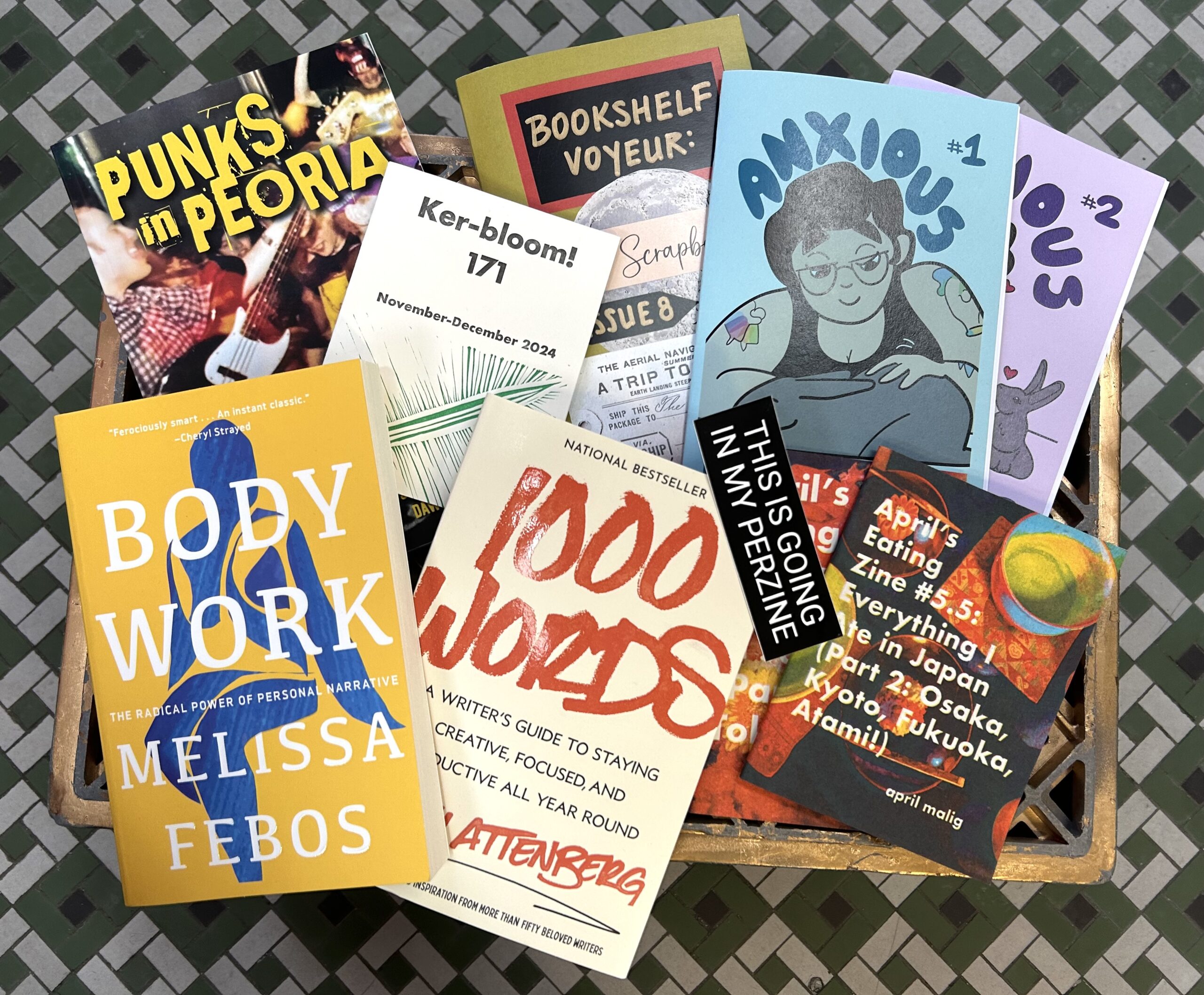
A pile of books and zines that tell personal stories, available at Quimby’s Bookstore in Chicago.

The world is a flaming mess right now. If you’re feeling overwhelmed, I’m right there with you. Whenever I’m struggling, I know that I can find respite in personal narratives. Reading about another person’s challenges, triumphs, sorrows, and joys reminds me that, as Adrienne Rich wrote, our stories flow in more than one direction.

Our shop is, of course, packed to the brick walls with vibrant voices on the page. Here are a few of the tales in which I’ve taken solace lately.

Every single issue of Lucinda J. Williams’ Bookshelf Voyeur series is a pure delight. Her latest release, #8: On Scrapbooks, delves into the fascinating lives that the zinemaker first encountered within a collection of turn-of-the-century ephemera.

Anxious Critters #1 and #2: I adore this pair of sweet zines about the relationship between creator Alex O’Keefe and her housemate: A very cute bunny named Ivy.

Although I’m a native Chicagoan, I’ve lived a good chunk of my life in small Midwestern towns, each with its own unique DIY community. Punks in Peoria: Making a Scene in the American Heartland by Jonathan Wright and Dawson Barrett takes a compelling look at how the hardcore punk movement played out in one central Illinois city in the ’80s and ’90s.

When someone I know returns from a trip, the first thing I ask is what they ate during their journey. April Malig chronicles her culinary adventures, with words and gorgeous colorwashed images, in April’s Eating Zine #5: Everything I Ate in Japan (Part One: Toyko!) and April’s Eating Zine #5.5: Everything I Ate in Japan (Part 2: Osaka, Kyoto, Fukuoka, Atami!).

I love a pocket-size zine, since I like never want to be without a story to get lost in. Ker-bloom! always delivers a perfect bite-sized tale presented in a beautiful letterpress package. Issue #171 begins with the epic statement: “Sometimes it pays to be a known Lord of the Rings nerd.”

So perhaps you’d like to add your own story to the glorious chorus of voices in this universe? We’ve got two of my favorite books about writing in stock right now. 1000 Words: A Writer’s Guide to Staying Creative, Focused, and Productive All Year Round by Jami Attenberg and many of the writer’s literary friends — including Carmen Maria Machado, Roxane Gay, and Kiese Laymon — just came out in paperback. Body Work: The Radical Power of Personal Narrative by Melissa Febos is the book I would put into the hands of any storyteller who wants to deepen their own practice.

If you do decide to share your story with the world, please consider putting it into a zine and consigning it with us! You might want to grab a This is Going in My Perzine sticker to give folks a heads-up. 🙂

—   With love and solidarity, C.E. Hanifin
Recommended Reading: Adam Gnade and his Great American Novels

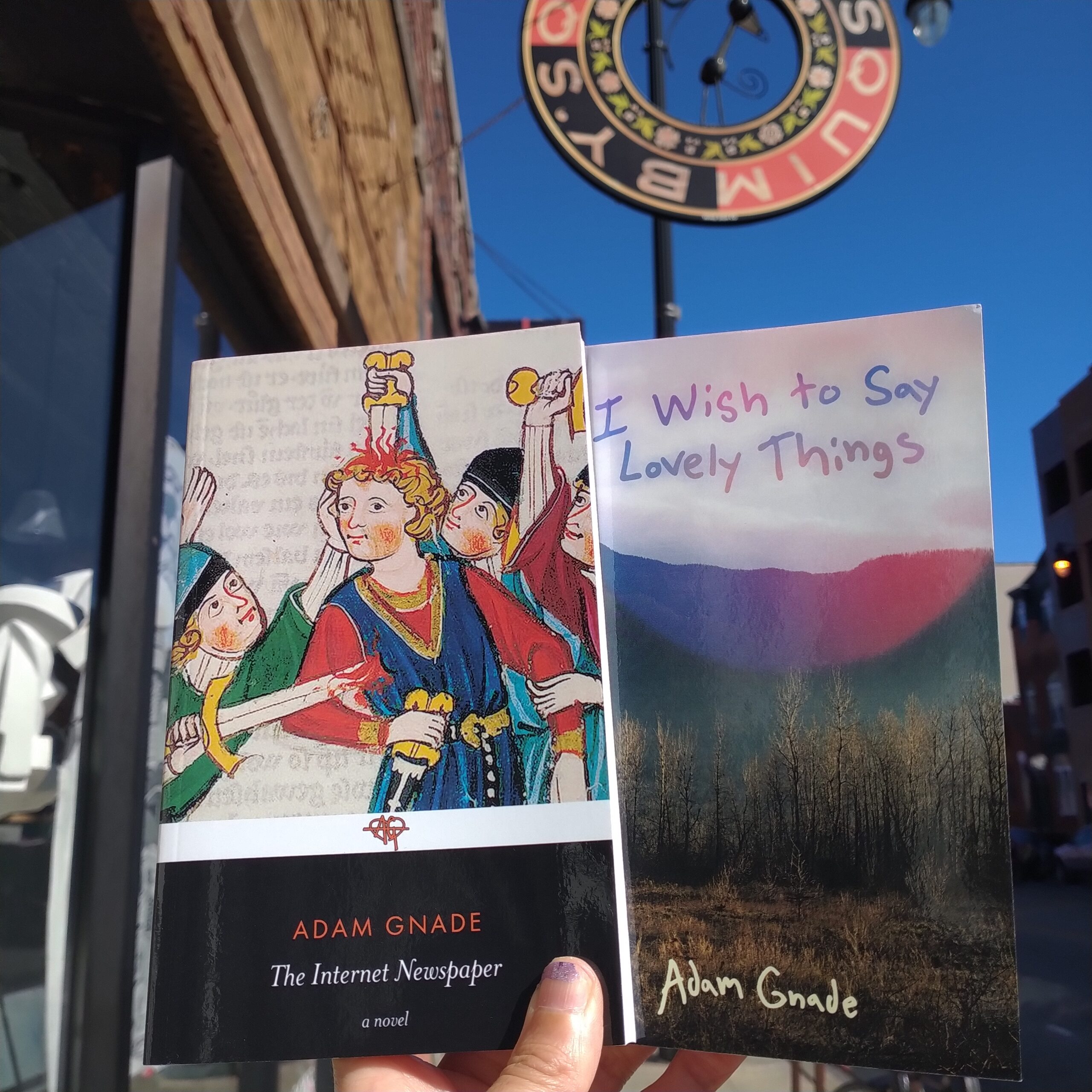
As of late, I’ve been deep into Adam Gnade‘s pocket sized novels ever since we received a large box of them from Kansas, where the author resides. Gnade (pronounced GUH-NAH-DEE) writes about coming of age in America, friendship, and being involved in alternative music scenes in the early aughts, a time when smartphones hadn’t been invented and the world felt less chaotic and broken.

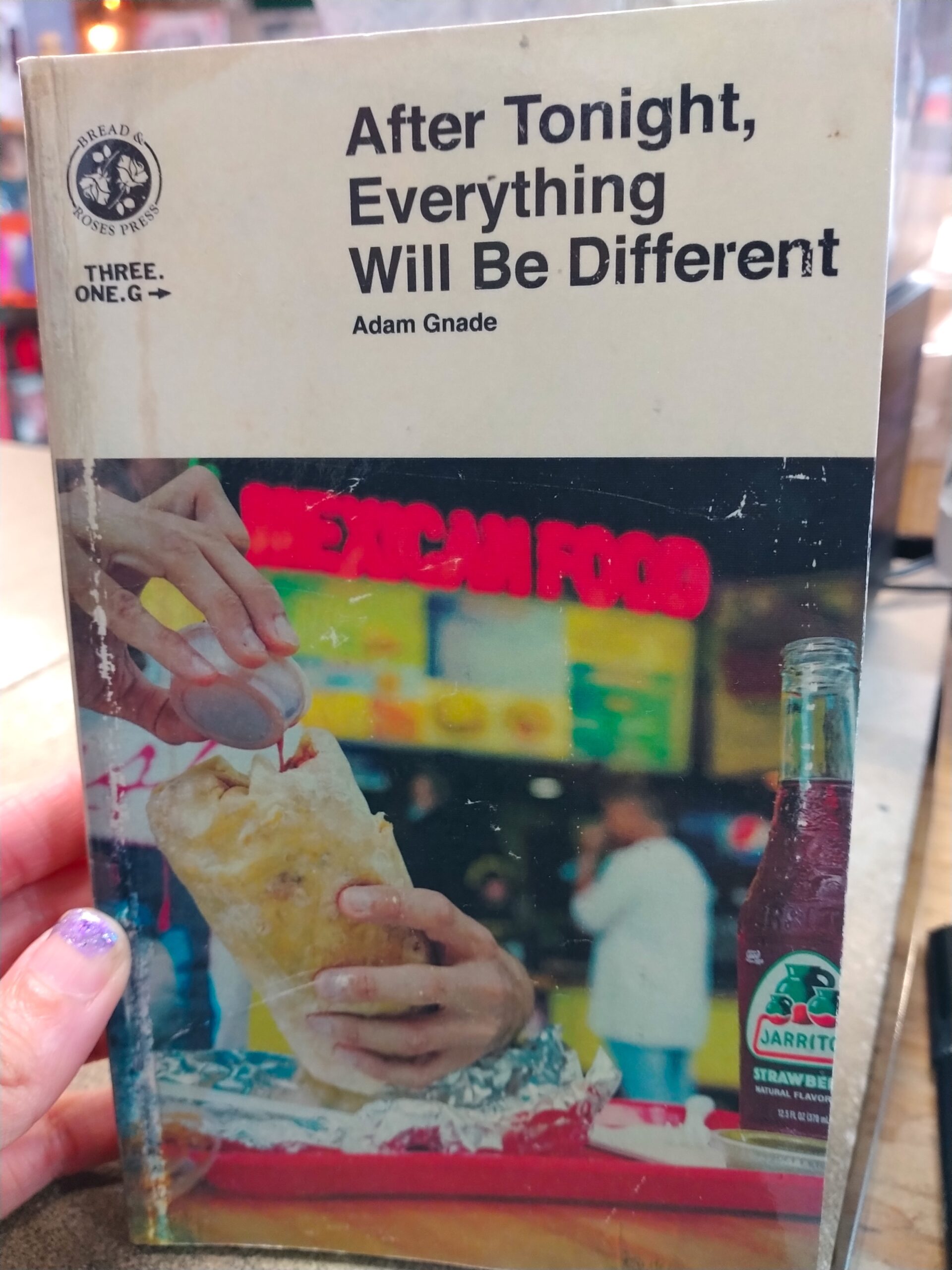
After Tonight, Everything Will Be Different drew me in with its cover: a picture of a hand pouring hot sauce on a giant burrito inside a taqueria. Maybe I was hungry that day, but something nudged me to buy it (we sold two other copies in the same day, perhaps there was something in the air). After Tonight… is set in San Diego, CA centered around the main character’s memories of growing up in the beachy California town where his parents owned a seafood restaurant. Each chapter is centered around a specific food memory and how the meals or snacks comforted James and his pals after late nights at punk shows, bars, and nights out when the only thing that mattered was being in the moment and escaping reality with chosen family. Despite each chapter being centered around food, the book reads more like an autobiography filled with visceral memories and the pain of early adulthood when you and your friends move on, go to college, or stay put in your hometown and waste time trying to figure out who you are and what you want to be. Gnade has a poetic way of retelling memories that pull the reader into his world by making them relatable and tender.

When you make sense to someone it is a lovely thing. What you are doesn’t tire them or make them nervous or scare them off. They see you and you make sense. Your weird shit makes sense. Your fears and delusions make sense. The things you love make sense. If you don’t make sense, it’s like a bitter flavor in a thing that should be sweet and it’s confusing to people. They don’t get you, and because they don’t get you, you’ve got no chance of being their friend. At 16 I want nothing more than to make sense to people, but I don’t make sense to anyone.

This beautiful paragraph is from the chapter titled “BURRITOS, VARIOUS.

The second book in Gnade’s pocket sized series of America is The Internet Newspaper. In the sequel, we follow James for three days in the year 2000 as he temps for a local internet newspaper in San Diego writing clickbait articles about cats and listing local music events. At night, he’s raiding the alcohol cabinet of a stranger’s home with friends while they house sit and driving to Tijuana with his coworkers for a press junket and getting drunk on the company dime. The Internet Newspaper captures a time when the internet was a place where information was less available and more casual, not all encompassing like it is today. The book is not just about the internet and the experience of having your first grown-up job, but about the main character’s life as a twenty-something punk having fun with friends while battling debilitating depression and suicidal ideation.

As I savor the last few pages of The Internet Newspaper, I look forward to reading I Wish to Say Lovely Things, Gnade’s follow up novel about love in all its many forms.

tl;dr Adam Gnade makes reading fun, inspiring, accessible, and cool with his badass autofiction novels.

*xo~Angel~xo*

@angel.xoxoxoxox

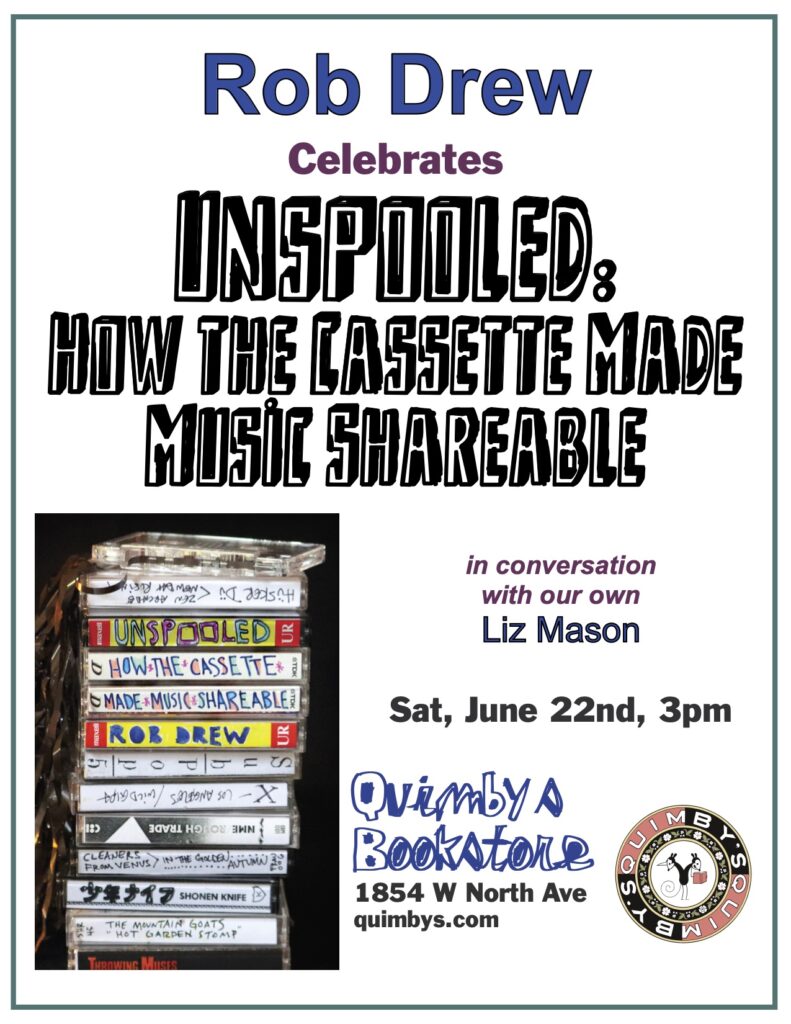
Rob Drew Celebrates Unspooled: How the Cassette Made Music Shareable, June 22nd

Jun ’24
22
3:00 pm

Rob Drew Celebrates
Unspooled: How the Cassette Made Music Shareable,
In Conversation with Liz Mason
at Quimby’s Bookstore
1854 W. North Ave
Saturday, June 22nd, 3pm

Quimby’s welcomes Rob Drew to celebrate the release of his book Unspooled: How the Cassette Made Music Shareable on Saturday, June 22nd at 3pm, in conversation with Quimby’s manager Liz Mason.

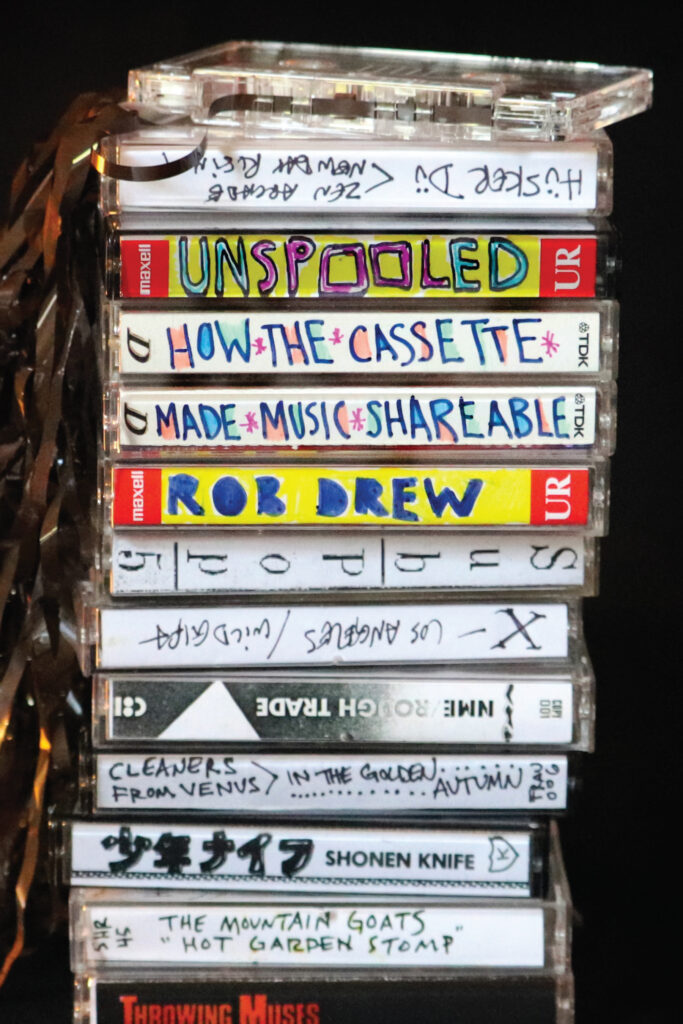
Join us to hear Dr. Rob Drew trace the history of the cassette tape, a cheap, low-fidelity music medium that fans grew to love. Rob will discuss how cassettes upended the music industry, inspired independent musicians, and initiated rituals of music sharing through mix tapes.


Well into the new millennium, the analog cassette tape continues to claw its way back from obsolescence. New cassette labels emerge from hipster enclaves while the cassette’s likeness pops up on T-shirts, coffee mugs, belt buckles, and cell phone cases. In Unspooled, Rob Drew traces how a lowly, hissy format that began life in office dictation machines and cheap portable players came to be regarded as a token of intimate expression through music and a source of cultural capital. Drawing on sources ranging from obscure music zines to transcripts of Congressional hearings, Drew examines a moment in the early 1980s when music industry representatives argued that the cassette encouraged piracy. At the same time, 1980s indie rock culture used the cassette as a symbol to define itself as an outsider community. Indie’s love affair with the cassette culminated in the mixtape, which advanced indie’s image as a gift economy. By telling the cassette’s long and winding history, Drew demonstrates that sharing cassettes became an acceptable and meaningful mode of communication that initiated rituals of independent music recording, re-recording, and gifting.

“Offering a comprehensive history of the cassette from its origins in post-World War II taping technologies to the recent revival of the music cassette as a hipster artifact, Unspooled is the first book to give an extended account of the various ways that cassettes have transformed musical culture. This wonderfully engaging, clear, and witty book will appeal to a wide audience of music fans and critics interested in mixtapes, cassettes, and cassette culture and will become a classic in many fields.” -Will Straw, Professor of Urban Media Studies, McGill University

“Rob Drew is one of my favorite writers on music, and I wish more people knew about his work. This is the definitive cultural history of indie music’s tangled but fascinating love affair with the audiocassette.” -David Hesmondhalgh, author of Why Music Matters

“Any readers who have ever received or created a mixtape will appreciate this narrative. A solid blend of history and nostalgia about cassette tapes that’s perfect for Gen Xers.” -Tina Panik, Library Journal

“The story of the cassette tape Drew and Masters tell is compelling: how a lo-fi, accident- and deterioration-prone, and more-or-less parasitic audio technology not only achieved market dominance but captured a permanent place in the imaginations and practices of music-makers, labels, distributors, and fans the world over. Unspooled and High Bias show readers that the peculiar technology of the cassette tape exemplifies the inherent contradictions of popular music perhaps better than any other medium.” — David Pike, Popmatters

“Divided into six sharp chapters, Unspooled walks readers through the rich history of music nerds who used cassettes in ever-evolving ways. By following the chronology, Drew provides a detailed exploration of the cassette in terms of format, medium, and artifact.” — Adam P. Newton, Treble Zine (Read the full review here.)

Rob Drew is Professor of Communication at Saginaw Valley State University and author of Karaoke Nights: An Ethnographic Rhapsody. Follow him at @slobster48602

Liz Mason is the manager of Quimby’s Bookstore, a zine publisher, a mix tape aficionado and a karaoke enthusiast. Follow her at @caboosezine

Want the Facebook event invite for this? Here ya go!

Watch Rob on the “Cassette Books Mixtape” panel with Marc Masters (High Bias: The Distorted History of the Cassette Tape), Jerry Kranitz (Cassette Culture: Homemade Music and the Creative Spirit in the Pre-Internet Age), moderated by Tom McCourt.

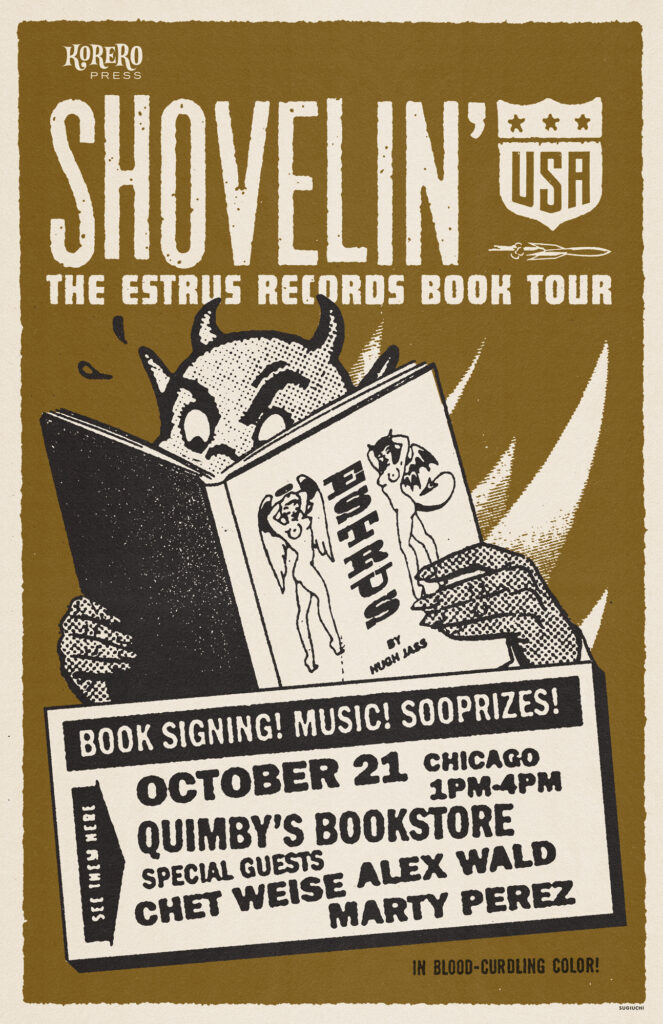
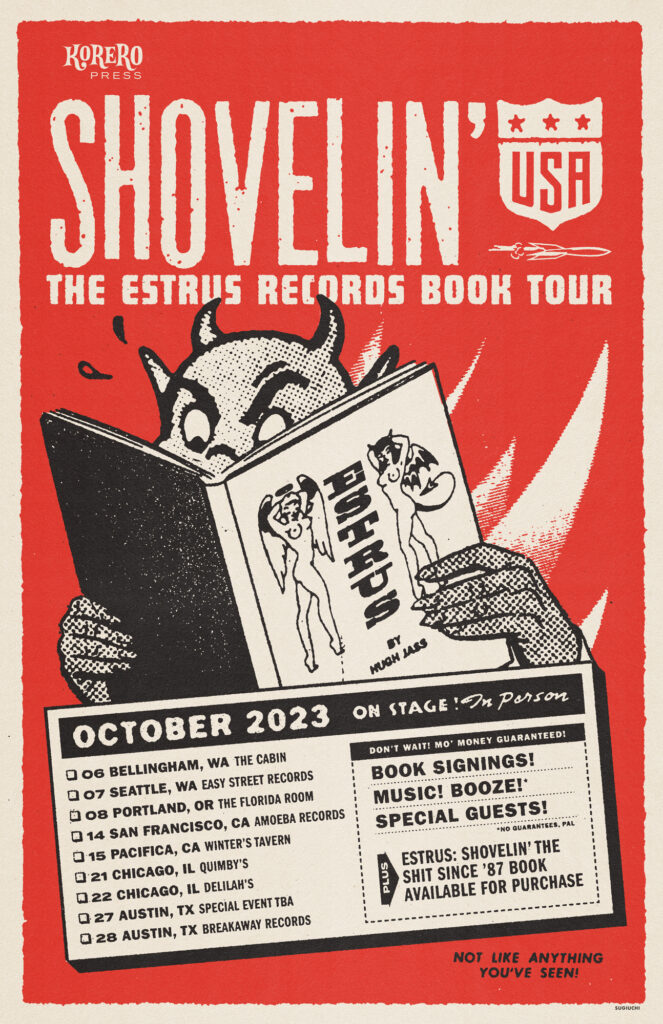
Shovelin’ USA: The Estrus Records Book Tour Stops at Quimby’s, Oct 21st

Oct ’23
21
1:00 pm

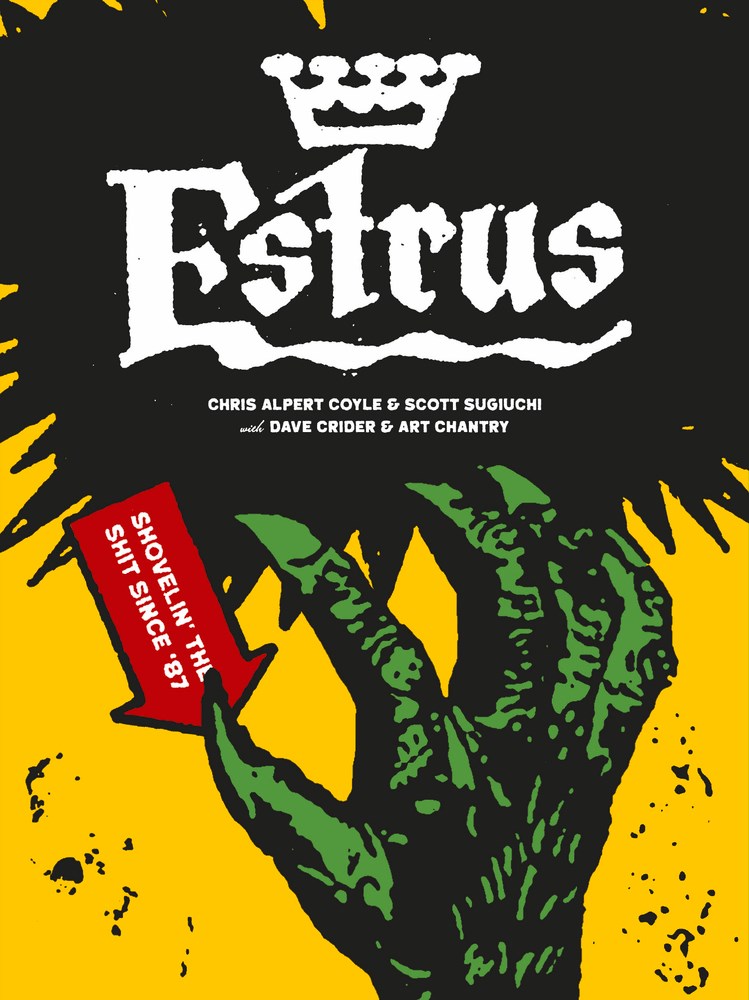
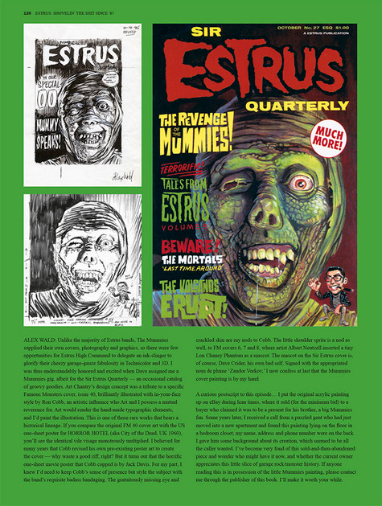
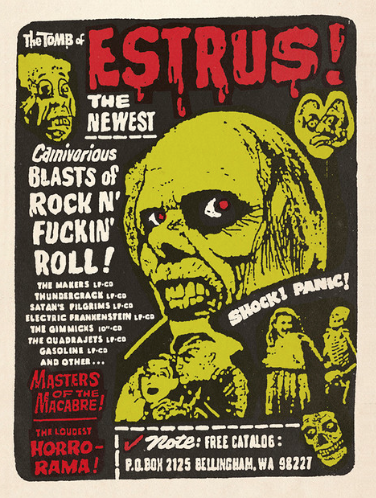
Korero Press is happy to announce that a hefty slab of punk rock history is coffee-table-ready: Shovelin’ The Sh!t Since ’87 is a 250+ page book of influential artwork, photographs, interviews and text detailing the history of the legendary garage rock label, Estrus Records. For nearly two decades, Dave Crider’s Bellingham, Washington-based operation churned out hundreds of releases from mainstays in garage, trash, surf, and punk — among them, The Mummies, Man or Astroman?, The Makers, Teengenerate, and Crider’s own Mono Men. And because the imagery associated with Estrus’ releases matched the ferocity of the music, this beast is filled with vivid concert posters, iconic album covers and bizzare oddities created by a handful of elite graphic artists — including visionary Art Chantry, who was behind much of the label’s artwork.

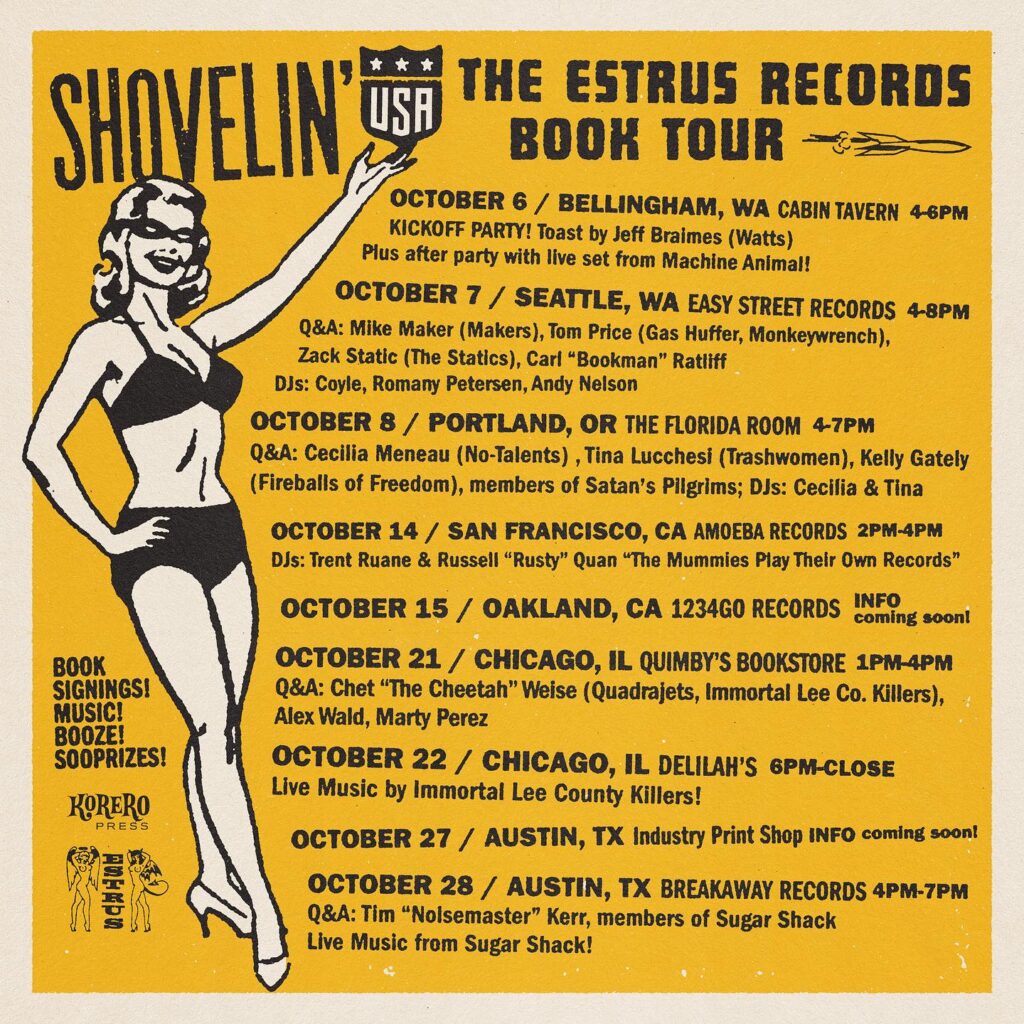
Author Chris Alpert Coyle and designer Scott Sugiuchi are taking copies of the new book with them on the Shovelin’ USA Tour. Join them here at Quimby’s Bookstore in Wicker Park on Saturday, October 21st beginning at 1pm. The Q&A session with Chet “The Cheetah” Weise (Quadrajets, Immortal Lee Co. Killers), Alex Wald & Marty Perez will be an opportunity for folks to ask questions about the iconic label’s history — and Coyle and Sugiuchi can give insight on what the multiyear project was like.

The book does not go on sale to the general public until late November, so Quimby’s will be one of the few places people can buy it ahead of time at the event on October 21st!

FREE EVENT!

Bios!

Chris Alpert Coyle is a nomadic music journalist (and serious journalist) whose material has been featured on CBS News, WGN, CBS Radio and The Inlander. As a musician, he has toured much of the United States with two different punk rock combos. As an outside linebacker for the ’79 Pittsburgh Steelers, wait…Different guy, actually. Never mind. Yeah, this guy (above) just writes stuff.

Scott Sugiuchi has been designing for more than 30 years. Highlights include work for Artisan Films (The Blair Witch Project), the American Film Institute and countless bands, record labels and venues. He is the founder of Hidden Volume Records, a boutique record label with more than 50 releases and is currently the Art Director for Alamo Drafthouse Cinema. He lives in Santa Fe, New Mexico.

Chet Weise’s poetry and fiction have appeared or been anthologized in publications such as Apocalypse Now: Poems and Prose from the End of Days, Birmingham Poetry Review, Constant Stranger: After Frank Stanford, Copper Nickel, Peach Mag, and the Rough Trade 40th Anniversary Journal. A musician, too, Weise toured and recorded with groups The Quadrajets and ?the Immortal Lee County Killers?. He was banned from Canada during 2008. Weise currently lives in Nashville, Tennessee, where he is the editor at Third Man Books and plays guitar in Kings of the Fucking Sea.

Alex Wald: Painter; illustrator for Estrus Records, Wired, Playboy, Hustler, many more; comic artist and colorist, art director, First Comics; kaiju scholar and collector, Astromonster Co., Ltd. designer and proprietor; blues harp player, ex-Dirty Wurds, Sunnyland Slim, Johnny Young and others; still making coffee.

Marty Perez is a Chicago-based photographer who has been documenting the parallels between the worlds of underground rock as well as some of the biggest stars of pop music, from 1976 to the present.

Very important links!

Facebook Event Post

instagram.com/estrus_records_book

facebook.com/estrusrecordsbook

koreropress.com/estrus-shovelin-the-shit-since-87

kickstarter.com/projects/estrus/estrus-shovelin-the-shit-since-87

Alexander Herbert Talks About What About Tomorrow? An Oral History of Russian Punk at Quimby’s 10/19

Oct ’19
19
7:00 pm

What About Tomorrow? An Oral History of Russian Punk chronicles the history of punk rock in Russia from its earliest manifestation in 1978 to its current standing. It looks at how punk entered the Soviet Union and managed to persist despite the cultural police, how it struggled for definition in the 1990s, and how punks formed Antifa, animal rights, and feminist groups to help carve out safe spaces in an otherwise conservative country. The book is compiled from over one hundred interviews, fanzines, and releases, and is the first history of its kind in any language. 

The title of the book What About Tomorrow? is a call for punks around the world to think about what punk has meant, and what it should mean. At this discussion, author Alexander Herbert will talk briefly about why he researched the book, and then gives a brief chapter outline before talking about the larger narratives. Then, during the Q and A, he invites everyone to think about the successes and failures of Russia’s punk scene as a way of critiquing our own counter-cultures and learning to use them to  achieve the world we want. 

Alexander Herbert is a doctoral student at Brandeis University focusing on the history of the late Soviet Union. His research interests include social movements, youth culture, macabre film, music, and politics toward the end of the socialist experiment. He is a devoted father to a beautiful daughter, veteran vegan, self-ascribed environmentalist, occasional musician, opportunistic freelance writer and translator, and fan of beer and pickle pizza. 

Facebook Event Invite Here!