Archive for the 'fiction' Category

Page 2 of 9

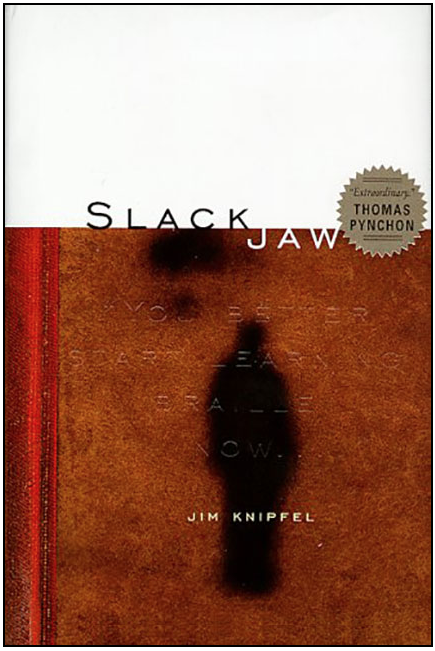
Quimby’s Welcomes Slackjaw Columnist Jim Knipfel, with Andy Slater 7/19

Jul ’18
19
7:00 pm

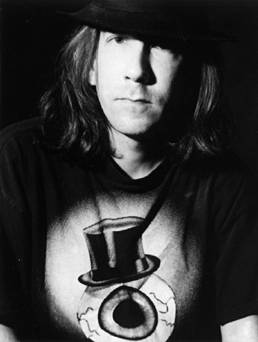
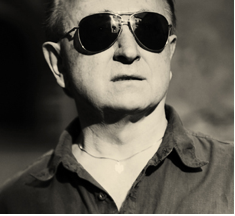
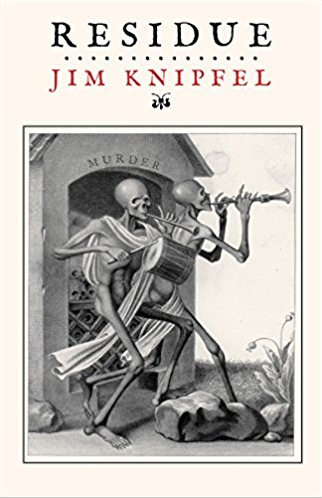
Born in Wisconsin, Jim Knipfel was a staff writer at the now-defunct weekly alternative newspaper New York Press for thirteen years, where wrote the long-running and popular “Slackjaw” column, a cynical, misanthropic look at daily life. He is the author of ten books, including Slackjaw, Quitting the Nairobi Trio, These Children Who Come at You With Knives, The Blow-off: A Novel, and, most recently, Residue. His work has appeared in The Wall Street Journal, The New York Daily News, The New York Post, The Village Voice, The Believer, OZY, and countless other publications. He’s also blind, and currently lives in the last remaining vestige of true Brooklyn.

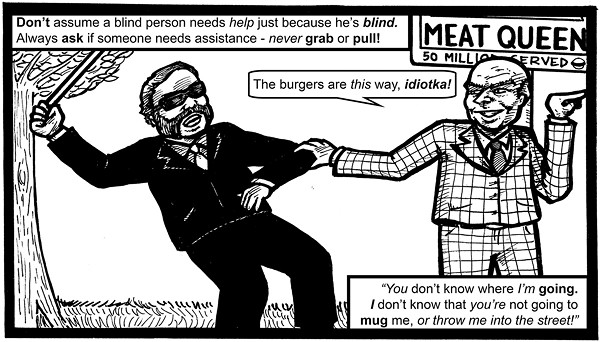
Self-described local blindo, Andy Slater aka Velcro Lewis, will host the event. Slater will be sharing excerpts from his comic How Many Fingers Am I Holding Up, his new stand-up act Permission To Fail, and details of his work with the Society of Visually Impaired Sound Artists.

This event is supported by 3Arts, Bodies Of Work, and the National Endowment for the Arts.

“[Slackjaw] is an extraordinary emotional ride, through the lives and times of reader and writer alike, maniacally aglow with a born storyteller’s gifts of observation, an amiably deranged sense of humor, and a heart too bounced around by his history, and ours, not to have earned Mr. Knipfel, at last, an unsentimental clarity that is generous and deep.” –Thomas Pynchon

“Life hasn’t been easy for Jim Knipfel. He’s blind…He’s got a drinking problem. He’s been in an out of mental hospitals. He’s attempted suicide. But he’s managed to keep his sense of humor.”—Boston Herald


Thurs, July 19th, 7pm

More info:

Facebook Invite For This Event

jimknipfel.com

missioncreep.com/slackjaw

electronpress.com

books by Knipfel 

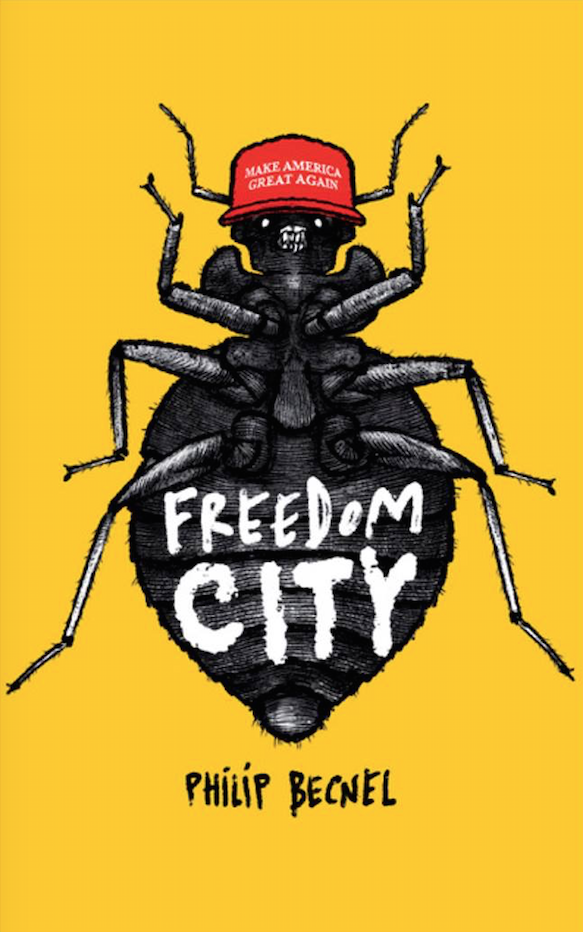
Philip Becnel Reads From Freedom City 6/22

Jun ’18
22
7:00 pm

In his debut novel FREEDOM CITY, Philip Becnel hilariously ridicules the current kakistocracy (government run by the worst people) in a gripping satire that pays homage to The Monkey Wrench Gang. After President Trump unceremoniously dies from a stroke, an eclectic band of rebels from Washington, D.C. sever the heads of Confederate statues and wage a comedic guerrilla war on post-Trump America. When President Pence enlists droves of fascist volunteers to crush the “alt-left” uprising, the rebels must risk their lives to run the fascists out of D.C. What follows is not only a battle for survival—but also a desperate search for remnants of what once made America great.

Someone at Netflix needs to check out Freedom City. It’s a short novel, but the character’s backgrounds could fill out a six part series! Hurry!” – Christopher Leibig, Author of Almost Mortal

FREEDOM CITY draws on Philip Becnel’s nearly 20 years of experience working as a private detective in D.C., where The Washington Post has referred to him as the “Bogart of body language” for his interviewing skills. He previously published Introduction to Conducting Private Investigations and Principles of Investigative Documentation, two books widely considered must-reads in the investigations industry. He has also written articles in a variety of legal and popular journals such as Time Magazine, and he has been interviewed by several major news organizations, including CNN and U.S. News & World Report, for his unique expertise and perspective.

For more info please visit https://philipbecnel.com.

Facebook Event Invite here.

Fri, June 22nd, 7pm – Free Event

Yuriy Tarnawsky Reads from The Placebo Effect Trilogy with Eckhard Gerdes 5/16

May ’14
16
7:00 pm

tarnawskyIn Ukrainian-American novelist Yuriy Tarnawsky’s new trilogy The Placebo Effect (JEF Books), the themes of alienation, abandonment, and fear of death, developed in Like Blood in Water and elaborated in The Future of Giraffes, respectively the first and second book of The Placebo Effect Trilogy, are picked up in the third book, View of Delft, and are given a new treatment.

Yuriy Tarnawsky has authored more than two dozen books of poetry, fiction, drama, essays, and translations.  He is one of the founding members of the New York Group, a Ukrainian émigré avant-garde group of writers, and cofounder and co-editor of the journal Novi Poeziyi (New Poetry; 1959–1972). He writes fiction, poetry, plays, translations, and criticism in both Ukrainian and English. His works have been translated into French, German, Hebrew, Polish, Portuguese, Romanian, and Russian. An engineer and linguist by training, he has worked as a computer scientist at IBM Corporation and professor of Ukrainian literature and culture at Columbia University. He writes in Ukrainian and English and resides in the New York City area. His other English-language books include the books of fiction Meningitis, Three Blondes and Death, Like Blood in Water (all FC2), and Short Tails (JEF Books), as well as the play Not Medea (JEF).

Tarnawsky takes risks most writers wouldn’t dream of.  Just when you think you’re on familiar ground, the earth begins to shake.  His writing rocks! —Derek Pell

Novelist and poet Eckhard Gerdes will also be  reading from some of his recent work.

Fri, May 16th, 7 pm – Free Event

For more info: egerdes(at)experimentalfiction(dot)com

To find this event on Facebook: https://www.facebook.com/events/262105330638172/

Q&A with Tonight’s Reader David Moscovich

David Moscovich

David Moscovich, author of You Are Making Very Important Bathtime, is no stranger to cross-country jaunts. The New York resident will be journeying here to Quimby’s for a reading with fellow writer Eckard Gerdes tonight. Nicki Yowell, Quimby’s Outreach and Communications Coordinator, caught up with David to chat about clumsy Japanese translations, the perils of teaching and the many iterations of his performances.

Quimby’s: You’ve resided in quite a few places during your life: Portland, New York, Boston, Japan. Would you say your personal well-rounded sense of place factors strongly into your work?

David Moscovich: My sense of place is probably more lopsided because of my personal geography — but being a Nebraska boy at root keeps me humble enough. Growing up in my own personal iron curtain as a Romanian-American in Nebraska gave me a sense of aloneness that didn’t disappear until I visited the old country as an adult. How does that translate into my work? I think it keeps experiences relative, and my attempt with Bathtime is to fuel misunderstandings between characters with even greater misunderstandings, to pose the assumptions of American and Japanese cultures in comical juxtaposition with each other. I try to expose the narrator’s biases and preconceptions in Bathtime by allowing him to gaff and to faux pas his way through most situations. In a sense, I tried to create a character who has committed a spiritual crime, a kind of culture-cide, but does not have the conscience to realize it. It torments him but not in the way a Raskolnikov is tormented.

Q: Flash fiction is a literary medium that seems to fit well with our times. Short, punchy, quick to get your attention. What draws you to shorter narratives? Are they more approachable in our temporally fractured culture?

DM: The way the story tells the story has to be more immediate in short fiction. I want to say more with less, and I also revise obsessively. It’s not that I am always drawn to the short form, but often I’ve cut back more than fifty percent of the words. You Are Make Very Important Bathtime is a complete rewrite of a much longer novel that I threw out to rework the voice. I wanted it to be about the voice. I also think of short fiction like punk rock. Put together fifty fast-paced songs and there is a concentrated performance that tells a longer story.

Q: The title of your latest book, You Are Make Very Important Bathtime, reminds me of a dubiously named website, Engrish.com. Translating Japanese to English can be a tenuous, problematic proposition, indeed. How does the central problem of language factor into the story?

DM: You Are Make Very Important Bathtime plays with the notion of weird, broken, unconventional and/or unaccepted grammar as a cause for celebration. Usually without thinking we accept grammar as a set of patterns that are “correct” in any given language without acknowledging that “correct” grammar might be viewed as merely another aesthetic.

Throughout the work is the comma splice, which came from a desire to intentionally circumvent the rules of punctuation and give the sense of reading each story in one long breath. The Japanese language also allows for females to refer to themselves by name. A character, Kimiko, says to the narrator: Kimiko loves okonomiyaki. These types of peculiarities fascinate me, like the fact that it’s possible to hold an entire conversation in Japanese without the use of a subject.

Language teachers might berate a student for collocational fumbles or syntactical mishaps but language itself loves errors and to me it sounds like poetry. Japanese is a very flexible tongue. Switch around verbs and nouns and leave out subjects, still we are understood. Languages are transforming, living beings, the long tentacles of cultures they are attached to. My attempt is to embrace all of it, to fully love the flexible grammar out there.

In one of the stories, a certain beer menu reads, “Please Choose the Drunk.” It’s incredible how much impact a single letter can have. And that is part of the book, this enormous potential that lies within the playing and shifting of letters.

Q: How has teaching shaped your point of view of writing? Do you ever picture your students as your audience or are you their audience?

DM: The goal for me is to marry writing and teaching by channelling them in a state of urgent transmission. Writing happens from a necessity of expression, as Rilke would have it. The delineation between teaching and the performance behind the writing disappears. That is the ideal — to share completely and selflessly what has worked for me as a writer, and equally so, what has not worked.

Q: Much of your work has a performance or performed component. You’ve done radio broadcasts and musical collaborations in addition to your live readings. Do you consider these performances to be separate and complete or a necessary companion to the written work you make?

DM: I like to think they compliment each other but ideally each stand alone. They are also different mediums. If a person prefers reading without the social aspect necessary for performance they can read instead. What I’m trying to do with the live performance is to offer something from my work that a reader cannot get just holding the book. But even within reading a written story to oneself there are so many possibilities. Any book could be read in a non-linear fashion as well as the traditional way from the first story to the last. You Are Make Very Important Bathtime was designed as a book to be read in any and every order whatsoever. The sequence offered in the book as published could be thought of as a “serving suggestion.” The reader sets the table.

Danny Bland Reads from In Case We Die 10/2

Oct ’13
2
7:00 pm

incasewediecvr

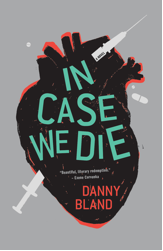
This debut novel by veteran Seattle musician Danny Bland follows a pair of outsiders who find themselves locked in the palpable, dizzy grunge-rock scene of early ’90s Seattle. Drenched in cloud of second hand smoke, Bland’s prose is funny and heart-breaking as he explores falling in and out of love, redemption and what you will and won’t do for one more cheap thrill all backed by the swelling sound of electric guitars, booze and petulant misbehavior.

“Our anti-hero is floating in a tiny lifeboat made of heroin, graveyard shifts & rock music. His companions are two fabulous women: a bombshell who robs banks & a beautifully pale rock violinist who can barely dodge suicide. ICWD is much funnier & more satisfying than any other junkie rock’n’roll tragedy.” – John Doe (X)

Danny Bland has been a musician (The Dwarves, Cat Butt, Best Kissers in the World) and road manager (Dave Alvin, The Knitters, The Gutter Twins, The Supersuckers) for over 25 years. Born in South Carolina, the longtime Seattle resident is most likely in a Ford Econoline van on a long stretch of highway, driving a rock band to its next engagement.

Also available: A star-studded AudioBook featuring Duff McKagan, Marc Maron, Donal Logue, John Doe, Mark Lanegan, Mark Arm (Mudhoney), Norman Reedus and Lew Temple (The Walking Dead), Aimee Mann, and more! Visit InCaseWeDie.com to hear a sample.

“A great piece of work — full of filth and heart.”  –Steve Earle

For more info: www.fantagraphics.com/incasewedie

Contact: Jen Vaughn, Marketing and Outreach Manager vaughn(at)fantagraphics(dot)com

Wednesday, October 2nd, 7pm – Free Event